
Owen Jones ‘Telynor Seiriol’ (1860-1906)
Ganwyd Owen Jones (Telynor Seiriol) ym 1860, yn nhafarn ‘Y Britannia’, Llannerch-y-medd lle’r oedd ei dad John Jones (Telynor Môn) yn berchennog y tŷ. Cafodd John a’i wraig Margaret 4 mab a 4 merch. Aeth tri o’u meibion ymlaen i fod yn delynorion enwog yn eu rhinwedd eu hunain: ‘Telynor Seiriol’, ‘Telynor Cymreig’ a ‘Telynor Gwalia’.
Dywedwyd bod Owen y mab hynaf, a elwid yn ‘Telynor Seiriol’, wedi’i ‘fagu â thelyn yn ei ddwylo’ (Roberts a Rhydderch, 2000); wedi’i ddysgu gan ei Ewythr Owen (‘Telynor Cybi’), daeth yn un o’r telynorion gorau yng Nghymru.
Ym 1873, yn 13 oed, ymddangosodd ar y llwyfan yn eisteddfod Lerpwl a Phenbedw. Flwyddyn yn ddiweddarach roedd yn eisteddfod Workington yn Cumbria lle cyfeiriwyd ato fel ‘y telynor bach o Lannerch-y-medd’.
Mae cofnodion yr eisteddfod yn dangos iddo ennill Telyn Deires Gymreig hardd, wedi’i gwneud o bren tywyll (a roddwyd gan ‘Gyfeillion yr Wyddgrug’) yn eisteddfod Bangor ym 1874.
Chwaraeodd Owen y delyn hon ar y Maes yng Nghaernarfon ar 24 Hydref 1879 yn ystod cyhoeddi’r eisteddfod genedlaethol a gynhaliwyd yng Nghaernarfon y flwyddyn ganlynol. Gwasanaethodd fel y delynor swyddogol i’r Ffiwsilwyr Brenhinol Cymreig tan 1883.
INSERT PHOTO
Mae erthygl yn ‘The North Wales Chronicle’ ar 2 Gorffennaf 1887 yn adrodd digwyddiadau 22 Mehefin y flwyddyn honno pan ganiataodd ‘Gwarcheidwaid Undeb Ynys Môn’ i ‘garcharorion’ y Tloty ddathlu Jiwbilî Aur y Frenhines Victoria. Mae’r Chronicle yn adrodd bod: “Mr Owen Jones, the harpist of Llannerch-y-medd, also volunteered his services on the harp. This was a great acquisition. After doing justice to the plentiful supply of tea and bun loaf, and exceptionally good wheaten bread and butter, Mr J Jones, Britannia, being contractor, and the Rev. E.W. Davies addressed a few appropriate remarks on the occasion which were well received. At the conclusion of the speeches the inmates found themselves in the midst of heavy showers of sweets, nuts and cakes. …
Singing and dancing, accompanied by the harp, followed until eleven o’clock. After getting tired indoors, they went to the grounds in front of the house and danced until they were exhausted. The dancing and harp accompaniment being quite a new feature in the festivities at the workhouse, the inmates were highly amused….”
Astudiodd Owen am gyfnod byr yng Ngholeg Cerdd ‘Y Guildhall’ yn Llundain; wedi’i anfon gan ei dad, a oedd yn gobeithio y byddai’r telynor ifanc yn manteisio ar y cyfle i ddatblygu ei dalent. Dywedir bod cylch ffrindiau Owen yn Llundain yn cynnwys telynorion nodedig fel John Thomas, a oedd ar y pryd yn Athro’r Delyn yn y Guildhall ac yn ddiweddarach yn Delynor i’w Mawrhydi’r Frenhines Victoria. Manteisiodd Owen ar y cyfle i fyw bywyd i’r eithaf yn Llundain. ‘Yn hoff o ddiod gref, roedd yn mwynhau partio i oriau mân y bore a’r cyfle i ddysgu’r dawnsfeydd newydd ffasiynol ym mreichiau merched ifanc esgeulus y ddinas fawr.’ Rhedodd ei arian allan a bu’n rhaid iddo wynebu anfodlonrwydd ei dad. Honnodd Owen nad oedd am ddysgu mwy nag yr oedd wedi’i ddysgu gan ei ewythr o Gaergybi ac mae’n ymddangos bod dicter ei dad wedi’i dawelu.
Chwaraeodd ‘Telynor Seiriol’ y delyn deires drwy gydol ei oes ac ni fu erioed amser iddo chwarae’r delyn bedal yn gyhoeddus. O ganlyniad, plesiodd yr Anrhydeddus Augusta Hall, Arglwyddes Llanofer, y ‘Gwenynen Gwent’ – a weithiodd yn ddiflino drwy gydol ei hoes i gefnogi’r offeryn traddodiadol. Adroddwyd bod Owen wedi ymweld â Neuadd Llanofer sawl gwaith ac ar yr achlysuron hynny gwisgodd wisg Gymreig arbennig – gwasgod borffor tywyll, trowsus pen-glin, crys gyda ffrils ar yr arddwrn a bwclau arian.
Pan nad oedd yn chwarae’r delyn, roedd yn gweithio gyda’i frawd, ym musnes teilwra’r teulu. Roedd Owen yn gweithio fel ‘Torrwr’, hynny yw – y person sy’n cymryd mesuriadau cleient, yn dylunio patrwm y dilledyn, ac yn torri’r darnau ffabrig. Roedd ei weithdy drws nesaf i Dafarn y Britannia.
Ym 1893, gwahoddwyd Owen i fynychu’r eisteddfod yn Ffair y Byd yn Chicago ond methodd â mynd oherwydd ymosodiad o’r ffliw.
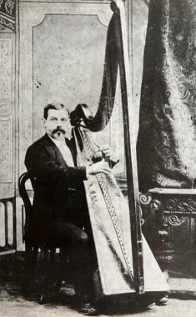
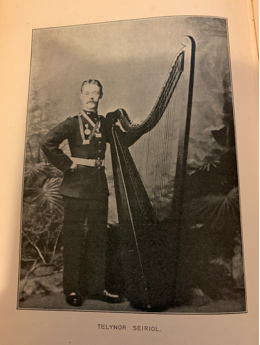
Mae’r ffotograff hwn yn dangos Owen yn chwarae ei Delyn Deires Gymreig – ymddangosodd yn rhaglen yr Eglwys Genedlaethol Frenhinol yng Nghaernarfon, ym 1894. Yn ystod yr eisteddfod, perfformiodd Owen gerbron Tywysog Cymru (Edward VII yn ddiweddarach) a chafodd ei wahodd i berfformio i’r Teulu Brenhinol ar y cwch hwylio ‘Britannia’.
Ym 1906, dim ond pythefnos cyn ei farwolaeth (yn 46 oed), gwnaeth Owen ei ymddangosiad cyhoeddus olaf mewn cyngerdd yng Nghaergybi. Adroddodd y papur newydd lleol fod sain y delyn deires bellach yn anaml yn cael ei chlywed yn y dref ac roedd pobl wrth eu bodd yn clywed Telynor Seiriol yn ‘tynnu mêl o dannau mân ei delyn’. Derbyniodd ei berfformiad rhagorol o ‘The March of the Men of Harlech’ ganmoliaeth uchel.
Yn ei flynyddoedd olaf, trodd Owen at ffydd a rhoi’r gorau i’w hen ddrygau. Ymunodd ag ‘Urdd y Temlwyr Sanctaidd’. Roedd yn ysgrifennydd y gangen leol ac yn aelod o fand pres y mudiad lle chwaraeodd y cornet. Roedd hefyd yn aelod selog o Gapel y Bedyddwyr, y bu’n rhaid iddo ei adael yn sydyn un prynhawn Sul ym mis Ebrill 1906 oherwydd ei fod yn teimlo’n sâl. Ar ei ffordd adref galwodd yn nhŷ’r Meddyg, ond ychydig oriau’n ddiweddarach, bu farw o drawiad ar y galon. Awgrymodd rhywun a oedd yn bresennol ar y pryd y dylid rhoi sip o frandi i Owen yn y gobaith y byddai’n ei adfywio. Ni wnaed hyn rhag ofn y gallai ‘ail-ddeffro ynddo’r awydd am ddiod gref’. … Efallai y byddai diferyn o frandi wedi’i achub. … Pwy a ŵyr?
Claddwyd Owen ym Mynwent Eglwys Santes Fair, Llannerch-y-medd. Adroddwyd am ei angladd yn ‘Y Cymro’ ar 3ydd Mai 1906. Dolen i erthygl papur newydd am gladdu ‘Telynor Seiriol’: https://newspapers.library.wales/view/3455345/3455347/6
Tafarn ‘Y Britannia,’ Llannerch-y-medd
Er nad yw’n dafarn bellach, gellir gweld arwydd boglynnog ‘Y Britannia’ hyd heddiw. Yn ystod y 19eg ganrif daeth y dafarn hon i gael ei hadnabod fel ‘Cartref y Delyn’. Estynnodd ei henwogrwydd i rannau eraill o Gymru ac ymwelodd rhai enwau mawr ym myd cerddoriaeth gyfoes â’r ‘Britannia’ – beirdd, adroddwyr straeon, cantorion a cherddorion. Mynychodd llawer o berfformwyr enwog ‘noson lawen’ yn Nhafarn y Britannia, a’r prif atyniad oedd sain y delyn a chanu’r ‘penillion’. Felly, cadwodd telynorion y Britannia draddodiad hynafol chwarae’r delyn yn Ynys Môn – dywedir y gallant olrhain eu llinach gerddorol yn ôl cyn belled â’r 14eg Ganrif.
Am ragor o wybodaeth a manylion am leoliad y ‘Britannia Inn’ dilynwch y ddolen we hon: https://historypoints.org/index.php?page=birthplace-of-harpist-owen-jones-llannerch-y-medd
Telyn Deires
Dechreuodd y cysyniad o adeiladu telyn gyda thair rhes o dannau yn yr Eidal, i ymdopi â’r math newydd o gerddoriaeth a oedd yn datblygu yn ystod yr 16eg Ganrif. Mae’n caniatáu i’r telynor chwarae nodiadau cromatig heb liferau na phedalau. Mae dwy res allanol y delyn deires wedi’u tiwnio i’r raddfa ddiatonig a’r rhes fewnol i’r nodyn damweiniol, gan wneud yr offeryn yn gwbl gromatig. Gellir cynhyrchu effeithiau sain sy’n benodol i’r offeryn trwy chwarae’r ddwy res allanol yn gyflym ar ôl ei gilydd, sain na ellir ei chael ar unrhyw delyn gydag un rhes o dannau.
Mabwysiadwyd y delyn deires yn gyflym gan delynorion Cymru a oedd yn byw yn Llundain yn ystod yr 17eg Ganrif. Roedd yn boblogaidd gyda’r boneddigion Cymreig yn ogystal â’r werin a chlywyd ei sain nodweddiadol mewn plastai, bythynnod cyffredin, tafarndai a thafarndai, mewn ffeiriau, dawnsfeydd, eisteddfodau, gwyliau, priodasau a dathliadau eraill. Roedd mor boblogaidd fel erbyn dechrau’r 18fed ganrif daeth y delyn deires yn adnabyddus yn gyffredinol fel y “delyn Gymreig”. Erbyn canol y 18fed Ganrif, roedd y delyn deires wedi mynd allan o ffasiwn ar draws gweddill Ewrop ond yma yng Nghymru parhaodd ei defnydd a daeth yn rhan o’n traddodiad.
Am ragor o wybodaeth, ewch i wefan cymdeithas y delyn deires Gymreig: https://cymdeithasydelyndeires.cymru
Owen Jones ‘Telynor Seiriol’ (1860-1906)
Owen Jones (Telynor Seiriol) was born in 1860, at the Britannia Inn, Llannerch-y-medd where his father John Jones (Telynor Môn) was the landlord. John & his wife Margaret had 4 sons and 4 daughters. Three of their sons went on to become famous harpers in their own right: ‘Telynor Seiriol’, ‘Telynor Cymreig’ and ‘Telynor Gwalia’.
Owen the eldest son, known as ‘Telynor Seiriol’ was said to be ‘nurtured with a harp in his hands’ (Roberts & Rhydderch, 2000); taught by his Uncle Owen (‘Telynor Cybi’), he became one of the best harpers in Wales.
In 1873, aged 13, he appeared on stage at the Liverpool and Birkenhead Eisteddfod. A year later he was at the Workington Eisteddfod in Cumbria where he was referred to as (the little harper) ‘y telynor bach o Lannerch-y-medd’.
Eisteddfod records show that at the Bangor Eisteddfod in 1874, he won a beautiful Welsh triple harp, made of dark wood (donated by ‘Cyfeillion yr Wyddgrug’).
Owen played this harp on the Maes in Caernarfon on the 24th of October 1879 during the proclamation of the National Eisteddfod held in Caernarfon the following year. He served as the official harper to the Royal Welsh Fusiliers until 1883.
An article in ‘The North Wales Chronicle’ on 2nd July 1887 recounts the events of 22nd June that year when ‘The Guardians of the Anglesey Union’ allowed the ‘inmates’ of the Workhouse to celebrate Queen Victoria’s Golden Jubilee. The Chronicle reports that:
“Mr Owen Jones, the harpist of Llannerch-y-medd, also volunteered his services on the harp. This was a great acquisition. After doing justice to the plentiful supply of tea and bun loaf, and exceptionally good wheaten bread and butter, Mr J Jones, Britannia, being contractor, and the Rev. E.W. Davies addressed a few appropriate remarks on the occasion which were well received. At the conclusion of the speeches the inmates found themselves in the midst of heavy showers of sweets, nuts and cakes. …
Singing and dancing, accompanied by the harp, followed until eleven o’clock. After getting tired indoors, they went to the grounds in front of the house and danced until they were exhausted. The dancing and harp accompaniment being quite a new feature in the festivities at the workhouse, the inmates were highly amused….”
Owen studied for a short period at the Guildhall College of Music in London; sent by his father, who hoped the young harper would seize the opportunity to develop his talent. It is reported that Owen’s circle of friends in London included distinguished harpists such as John Thomas, who was at that time the Professor of Harp at the Guildhall and later Harpist to Her Majesty Queen Victoria. Owen took advantage of the opportunity to live life to the full in London. ‘A lover of strong drink he enjoyed partying into the early hours and the opportunity to learn the fashionable new dances in the arms of the flighty young ladies of the big city.’ His money ran out and he was obliged to face his father’s displeasure. Owen claimed that he did not wish to learn any more than he had been taught by his uncle from Holyhead and it seems his father’s anger was assuaged.
‘Telynor Seiriol’ played the triple harp throughout his life and there was never a time that he played the pedal harp in public. As a result, he pleased the Honourable Augusta Hall, Lady Llanofer, the ‘Gwent Bee’ – who worked tirelessly throughout her life to support the traditional instrument. It has been reported that Owen visited Llanofer Hall several times on which occasions he wore a special Welsh costume – a dark purple waistcoat, knee breeches, a shirt with frills at the wrist and silver buckles.
When he wasn’t playing the harp he worked with his brother, in the family tailoring business. Owen worked as a ‘Cutter’, that is – the person who takes a client’s measurements, designs the garment’s pattern, and cuts the fabric pieces. His workshop was next door to the Britannia Inn.
In 1893, Owen was invited to attend the eisteddfod at the World Fair in Chicago but was unable to go due to an attack of influenza.
INSERT PHOTO
This photograph shows Owen playing his Welsh Triple Harp – it appeared in the programme of the Royal National Eisteddfod in Caernarfon, in 1894. During the Eisteddfod, Owen performed before the Prince of Wales (later Edward VII) and was invited to perform for the Royal Family on the yacht ‘Britannia’.
In 1906, just two weeks before his death (at the age of 46), Owen made his last public appearance at a concert in Holyhead. The local newspaper reported the sound of the triple harp was now rarely heard in the town and people were thrilled to hear Telynor Seiriol ‘drawing honey from the fine strings of his harp’. His outstanding performance of ‘The March of the Men of Harlech’ received high acclaim.
In his latter years, Owen turned to faith and gave up his former vices. He joined ‘The Order of the Holy Templars’. He was secretary of the local branch and a member of the brass band of the movement where he played the cornet. He was also a zealous member of the Baptist Chapel, which he had to leave suddenly one Sunday afternoon in April 1906 because he felt unwell. On his way home he called at the Doctor’s house, but only a few hours later, died of a heart attack. Someone present at the time suggested Owen be given a sip of brandy in the hope it might revive him. This was not done for fear that it might ‘reawaken in him the desire for strong drink’. … Perhaps a drop of Brandy would have saved him. … Who knows?
Owen was buried in St Mary’s Churchyard, Llannerch-y-medd. His funeral was reported in ‘Y Cymro’ on 3rd May 1906.
References
Roberts, H. and Rhydderch, L. (2000) “The Harpers of Llanerchymedd: The Britannia Family and others” Published by the Isle of Anglesey County Council, 2000. Department of Leisure and Heritage, Llangefni. Ynys Mon, LL77 7TW. Gwasg Dwyfor, Penygroes, Gwynedd. Wales, UK.
Translation of Report of Telynor Seiriol’s Burial (from ‘Y Cymro’ 3rd May 1906)
“On Wednesday a large crowd gathered in Llanerchymedd, Anglesey, to pay their last respects to the well-known harpist mentioned above. It was one of the largest funeral gatherings ever seen in the town. The whole country was upset by the suddenness of his death, and everyone showed their sorrow and grief. … He was sent to his final resting place in an honourable position amongst the harpists of his country, in recognition of the service he performed for the Gorsedd, the Eisteddfod, and at his country’s national festivals.”
Link to newspaper article about the burial of ‘Telynor Seiriol’: https://newspapers.library.wales/view/3455345/3455347/6
The Britannia Inn, Llannerch-y-medd
Although no longer a public house, the embossed sign of the ‘Britannia Inn’ can still be seen today. During the 19thcentury this inn came to be known as ‘The Home of the Harp’. Its fame extended to other parts of Wales and some great names in the contemporary music world visited the ‘Britannia’ – poets, story tellers, singers and musicians. Many famous performers attended ‘noson lawen’ at the Britannia Inn, the chief attraction being the sound of the harp and the ‘penillion’ singing. Thus, the Britannia harpers preserved the ancient tradition of harp playing in Anglesey – it is said they can trace their musical lineage back as far as the 14th Century.
For further information and details about the location of the ‘Britannia Inn’ follow this weblink:
https://historypoints.org/index.php?page=birthplace-of-harpist-owen-jones-llannerch-y-medd
Triple Harp – y Delyn Deires
The concept of building a harp with three rows of strings originated in Italy, to cope with the new type of music which was developing during the 16th Century. It allows the harpist to play chromatic notes without levers or pedals. The two outer rows of the triple harp are tuned to the diatonic scale and the inner row to the accidentals, making the instrument completely chromatic. Sound effects peculiar to the instrument can be produced by playing the two outer rows in swift succession, a sound which is unobtainable on any harp with a single row of strings.
The triple harp was quickly adopted by the Welsh harpers living in London during the 17th Century. It was popular with the Welsh gentry as well as the peasants and its characteristic sound was heard in mansions, humble cottages, taverns and inns, at fairs, dances, eisteddfodau, festivals, weddings and other celebrations. It was so popular that by the beginning of the 18th century the triple harp became generally known as the “Welsh harp”. By the middle of the 18th Century, the triple harp fell out of fashion across the rest of Europe but here in Wales its use continued and became part of our tradition.
For more information, please visit the website of the Welsh triple harp society: https://cymdeithasydelyndeires.cymru